Vipul Enterprises- A Name You Can Trust
Main menu
- Home Page
- Solar Products
-
Strategic Composite Systems
- Bullet Proof
- Riot Control
- Fire and Rescue
- Bomb Blanket
- Tankers And Refuelers
- FRP & Speed Boats
- Post Fence and Metal Angles
- Mobile Communication Towers
- Pre-Fab Shelters
- Clothing
-
Furniture
- File Cabinets, Almira And Trunks
- Tables, Chair And Desk
- Folding Cots
- Specialised Furniure / Hospital Furniture
- About Us
-
FAQ
- Solar Overview
- Solar FAQ
Jawaharlal Nehru National Solar Mission (JNNSM)
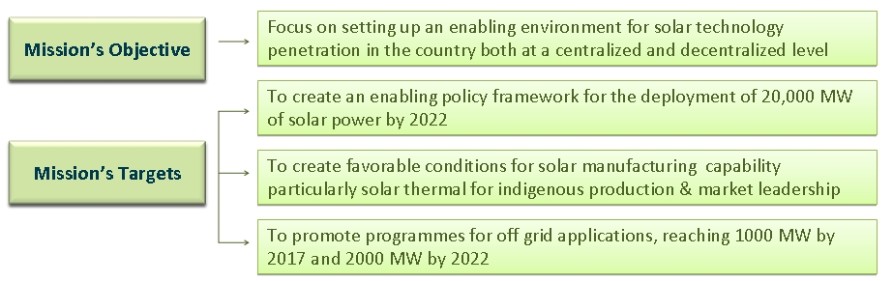
The National Solar Mission is a major initiative of the Government of India and State Governments to promote ecologically sustainable growth while addressing India’s energy security challenge. It will also constitute a major contribution by India to the global effort to meet the challenges of climate change.
Role of Various Agencies in Renewable Energy
1. Ministry of New and Renewable Energy
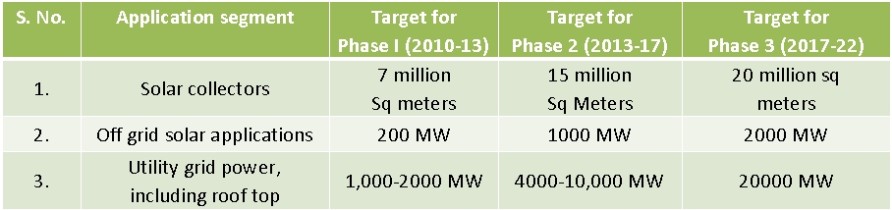
The Ministry of New and Renewable Energy (MNRE) is the nodal Ministry of the Government of India for all matters relating to new and renewable energy. The broad aim of the Ministry is to develop and deploy new and renewable energy for supplementing the energy requirements of the country. The JNNSM is following in the footsteps of countries successful in solar installations like Germany and Spain by using a combination of an attractive feed in tariff and a single point PPA. The broad targets of this mission are 1000 MW of grid connected, 200 MW of off grid solar power and 100 MW roof top installations by 2013 (phase I ) and a total of 20,000MW installed by 2022.
Category |
JNNSM target |
Incentives |
Solar PV |
Phase 1- |
Current CERC guidelines for Solar PV |
Roof top |
- |
2. NTPC’s Vidyut Vyapar Nigam Limited (NVVN) has requested Request for Selection (RfS) for New Grid Connected Solar Photovoltaic Projects under Phase 1 of JNNSM.
3. IREDA – The Indian Renewable Energy Development Agency is a Non-
4. Role of State Level Agencies
It is envisaged that the State Government shall appoint any Agency as a State Level Agency, which will provide necessary support to facilitate the development of the Projects. This may include facilitation in the following areas:
Access to Sites
Water Allocation for Solar Thermal Projects
Land acquisition for the project
Connectivity to the Transmission substation.
5. Role of Carbon Financing
Project developers are encouraged to identify the potential role of carbon finance in their investment analysis including:
The expected revenues from emission reductions; and
The cost of power with and without carbon revenues.
A Nodal Agency will be designated as the program coordinating entity for the purposes of facilitating the emission reductions benefits using the programmatic approach. It will perform this function in cooperation with project developers and other parties and in line with the tariff regulations laid down by CERC.
1,000 MW solar power (connected to 33 KV or more grid) to be purchased by NTPC Vidyut Vyapar Nigam (NVVN).
Tariff as fixed by Central Electricity Regulatory Commission (CERC).
Annual tariff review by CERC.
NVVN to bundle equivalent MW capacity of thermal power.
Utilities can meet their RPO by purchase of solar power.
MNRE would provide financial support upto 30% subsidy or Rs. 90/Wp with battery storage and Rs. 70/Wp without battery storage.
Interest bearing loans at 5%.
Benchmark price for photovoltaic systems with battery back-
up considered as Rs. 300/- .
PPA duration 25 years
Solar specific RPO starting with 0.25% in 1st phase, increasing to 3% by 2022 to be fixed after policy change
RE Certificate -
policy being finalized by Forum of Regulators